Monday, January 28, 2013

From Carcasses to Culinary Masterpieces {Edible Monterey Bay}

My piece about EcoFarm's first ever butchery skills seminar just went live on Edible Monterey Bay's blog tonight (January 29, 2013). Click to read it: here.


From Carcasses to Culinary Masterpieces:
EcoFarm’s First Ever Butchery Skills Seminar
Story and Photos by Camilla M. Mann


I have never had any illusions that meat just appears in the grocery store, headless, legless, and wrapped in paper or plastic. My circle of close friends includes hunters and fisherman, so I often get emails with photos of successful kills held aloft next to proud grins. And I relish getting deliveries of homemade sausages, cuts of wild boar and venison, whole crabs, and more. But until the EcoFarm’s 2013 Butchery Skills Seminar, last week, I have never seen a whole carcass broken down into saleable cuts.

Master butcher Rian Rinn, who will be opening his own shop in Santa Rosa later this year, and Marsha McBride, executive chef and owner of Café Rouge in Berkeley, led the all-day demonstration punctuated by lively discussions with the audience. Attendees hailed from all over the country – as far away as Illinois and as close as Carmel Valley – and our experience with raising and butchering livestock ran the gamut. We were a crowd comprised of seasoned ranchers, enthusiastic consumers, and everything in between.

Shae Lynn and Kevin Watt of Early Bird Ranch in Pescadero provided a forest-raised pig for our first demonstration: half-hog cutting.

Pointing at the pig, Rian instructed while we repeated, “Shoulder.” Shoulder. “Loin.” Loin. “Belly.” Belly. “Leg.” Leg. Then, armed with only a chef’s knife, a flexible boning knife, and a saw that he used sparingly, Rian skillfully guided us through cutting the pig into primals while offering suggestions for profitability. Marsha contributed cooking tips, including how to use the ears – blanched and atop a salad, the skin – in cotechino, and the leaf lard – for flaky, tender pastry dough.

Chef and restaurateur Jesse Cool of CoolEatz and Carlos Canada, executive chef of Jesse’s Flea Street Café, whisked some of the freshly cut meat into the kitchen for our appetizers and dinner at the end of the day.

Rian brought out the second half of the pig and focused on custom cuts and creating value-added artisan products. He detailed how to dry cure and age the leg to make prosciutto. When he demonstrated how to cut, roll, and tie a porchetta from the loin and belly of the pig, Marsha revealed that she stuffs the porchetta at Café Rouge with quince and various aromatics. One of the other attendees asked what I’m sure we were all thinking: “Where’s Café Rouge exactly?!”

Following a lunch break upstairs at the Cannery Row Brewing Company, we reconvened to watch Rian segment a grass-fed lamb from Doniga and Erik Markegard of Markegard Family Grass-Fed out of San Gregorio. Rian demonstrated techniques for frenching the rack of ribs, creating English-cut lamb chops, and deboning the leg two different ways – first by butterflying it and, second, by tunneling the bone out.

Rian’s partner Jenine Alexander coached us through a double-layer freezer wrap and a cone wrap. The former would be sufficient to keep meat fresh for at least a year in the freezer. Longer, even. We all had the chance to give our wrapping techniques a try.

The final cutting demonstration of the day involved a trio of chickens that were also provided by Early Bird Ranch. Rian depanned, shoving his knives back into the case strapped to his hip, “Just sell your chickens whole.” Still he chopped one of the birds using the four-piece cut and another using the eight piece cut.

To conclude the educational portion of the seminar we heard from Andrew Gunther, Program Director of the Animal Welfare Approved (AWA) program, and Marilyn Noble, Program and Communications Manager of the American Grassfed Association (AGA). Both organizations are focused on consumers’ growing interest in how farm animals are raised and the desire to know from where their food is coming and how it is produced. AWA certifies and promotes family farms that raise animals according to the highest welfare standards. AGA is advocating for stricter USDA guidelines on grassfed marketing claims which currently allow producers to claim “grassfed” when animals have only been “grass-finished.” The AGA, in stark contrast to the USDA, defines grassfed products from ruminants – including cattle, bison, goats and sheep – as those products from animals who have eaten nothing but their mother’s milk and fresh grass or grass-type hay during their lifetimes.

When I was recounting the seminar to a friend, she asked if seeing the process of butchering animals – severing heads and sawing limbs – made me want to become a vegetarian. On the contrary, what I saw and the discussions I had were illuminating and inspiring.

Jeremiah Stent and Bill Milliot, both of TomKat Ranch and LeftCoast Grassfed, described how they were developing a working ecosystem by balancing the relationship between the grass and the grazers. They rotate their livestock – a complementary mix of grazing animals – through a series of paddocks to allow the grasses to recharge; for example, they follow the cattle with chickens who scratch through the cow patties, eating the larvae and naturally controlling fly populations. Pastured pigs are also part of their multi-species grazing plan because pigs have different grazing patterns than cows. The idea: a mix of dietary preferences and grazing behaviors results in greater plant utilization, a better ecological balance among plant species, and increased production from a single unit of land.

Another ardent land steward, Mike Irving of Fifth Crow Farm in Pescadero strives to produce nutritious food while maintaining the health of the soil and surrounding ecosystem. His farm yields a dizzying array of crops, including Hopi blue corn that they sell as a corncake/cornbread mix; heirloom dry beans that are still-life worthy with their vibrant shades and patterns; twenty-four varieties of apples; brassicas, alliums, bunching greens, salad greens, root crops, and more. On the livestock front, Mike raised two pigs for his own use last year and was curious about butchering pigs in-house in the future.

With our heads crammed full of carcass diagrams, different meat cuts, and recipe suggestions, we were ready to enjoy some of the meat from the day, crafted into seasonal dishes by Chef Jesse and Chef Carlos.

While we continued to mingle, we noshed on tender cubes of lamb in a verdant pool of pesto. The meat was incredible – probably because it was cut from a carcass only a few hours prior and due to expert preparation by the chefs. Still I was motivated to purchase some of the lamb that was offered to us at better than market rates to try my hand at some lamb dishes.

As we settled down to dinner, the chefs addressed the group. Having been dedicated to sustainable agriculture and cuisine for nearly four decades, Chef Jesse is a fervent advocate for local, sustainable, and organic food production. She raised a glass in appreciation to those to whom she referred as her heroes, the farmers, the first real environmental pioneers.

Chef Carlos described our dinner as a pork grab bag; not everyone would be served the same dishes. Exchanging glances with my tablemates, we made a tacit pact to share so that we could taste all of the culinary masterpieces.


To end our day at the first ever EcoFarm’s Butchery Skills Seminar, we dined on delicious pieces of pig – pork chops and pork belly – that Master Butcher Rian Rinn had cut earlier in the day. Chefs Jesse Cool and Carlos Canada topped the pork with a peach mustard and plated it with heaps of winter vegetables. Roasted turnips and carrots, sautéed Brussels sprouts, and a creamy potato gratin rounded out our feast. From carcasses to culinary masterpieces, it was quite a day!

Tuesday, December 11, 2012

Dancing on Your Palate

A Food52 Potluck on the Monterey Peninsula
Story and Photos by Camilla M. Mann

The etymology of ‘potluck’ falls into two camps. One camp clings to the literal compound – pot + luck – and credits its first use to Thomas Nash, a 16th century British writer, to mean food cooked for an unexpected or uninvited guest, as in the guest gets “the luck of the pot” or whatever the cook has on hand. Another camp claims that it’s the misspelling of the Native Americans’ potlatch. Potlatch from the Chinook, means "to give away" or "a gift;” traditional potlatch ceremonies, in the Pacific Northwest, involved the redistribution of wealth within a community and were accompanied by singing, dancing, and bartering, as well as feasting. The only thing a potluck and a potlatch have in common: it’s a meal with no particular menu. Each participant brings dishes to share with others.

When I agreed to host a potluck, during the month of December, for the publishers of Food52 to celebrate the launch of their second cookbook, I didn’t take into consideration just how jam-packed my schedule was. To the usual holiday madness, add my little one’s birthday, the annual holiday fund drive for the foundation that I chair, birthday parties for four of our close friends, two of those whose birthday treats I always make, two rounds of Secret Santa, and parties upon parties upon parties. December quickly descends into chaos with sticky notes all over my calendar to remind me where I’m supposed to be next. So, what was I thinking committing to putting together a potluck where guests were invited to bring dishes from Food52’s website?!? Clearly, I wasn’t.

Thankfully, my parents decided that their annual holiday party would be the perfect venue for a Food52 potluck. They invited several friends from their ballroom dancing circle – artists, retired teachers, meteorologists, and more. It was quite a multi-talented group. They dance, they play instruments, they sing, and they cook. All I had to do was put together some foodie schwag bags – from Food52’s sponsors –, cook, show up, take some photos, scribble some notes, and taste the dishes that paraded through the door.

Steve, who owns his own outdoor pizza oven, baked some rosemary focaccia. Based on his vast experience with turning yeast, flour, salt, and warm water into pillowy goodness, I don’t think that he used a Food52 recipe; but if he had, this one might be close.


Yi selected Absurdly Addictive Asparagus, the Best Asparagus Recipe Contest winner posted by kaykay. She reported that the recipe was easy to follow and she really loved the photographs. The resulting dish was delightful. It was, as promised, absurdly addictive and I’ll be making it again soon.


Theo brought Thanksgiving Osso Buco posted by QueenSashy in the Best Thanksgiving Turkey Recipe Contest. Though this didn’t win that contest, it was a winner in our book. And, it turns out that this was the second time that Theo made the osso buco. His first attempt used chicken while his potluck offering was made with turkey. The chicken rendered the dish too dry, so he swapped poultries. Osso buco is traditionally made with veal shanks. That I knew, but I learned that osso buco also requires that the meat and bones be cut in a particular way; they are cross-cut with the bone in. As soon as Theo lifted the lid off his dish, the aromas of allspice, cinnamon, and nutmeg swirled together and made my mouth water.


Other dishes included roasted pork tenderloin, clam chowder, greens with poached pears, wild rice salad, and the two dishes that I made with my current culinary obsession: fennel pollen. I made a fennel-barley soup and a roasted fennel dip [click the names to read the recipes on my kitchen blog, Culinary Adventures with Camilla]. An article I read about fennel pollen dubs it “culinary fairy dust” and I couldn’t agree more. Just a sprinkling takes a dish from delicious to divine.

I was thankful for the opportunity - from Food52 - to get some likeminded people around tables who were willing to explore the collection of recipes...and share their creations.

This gathering of dancing cooks was, as a potluck should be, a communal feast full of laughter and libations.


*Full disclosure: In exchange for hosting this potluck, I am receiving complimentary copies of The Food52 Cookbook, Volume 2: Seasonal Recipes from Our Kitchens to Yours, beans from Rancho Gordo, and butter from Olli's Handcrafted Cultured Butter.

Monday, December 3, 2012

Edible Notables: La Balena

This piece - part of Edible Notables - was printed in Edible Monterey Bay's Winter 2012 issue, hitting news stands on December 1, 2012. Read the entire issue online here.


LA BALENA
A California restaurant with a Tuscan heart
 Story by Camilla M. Mann
Photo by Geneva Liimatta

Carmel’s budding community of young, creative and sustainability minded restaurateurs has just expanded with the addition of Anna and Emanuele Bartolini and their La Balena, an informal nod to Northern Italy on Junipero Street between Fifth and Sixth.

The Bartolinis had been tossing around the idea of opening a restaurant for more than a decade. Emanuele’s grandparents, who were originally from Sardinia, had a restaurant in Florence years ago, and after emigrating from Italy to New York, Emanuele started work in the city’s restaurant world before he even knew English. By the time he left New York to move to Carmel, he was working as a senior manager at Del Posto, which is owned jointly by Mario Batali and Lidia and Joseph Bastianich and is one of the most highly regarded Italian restaurants in New York. In Carmel, he was most recently a general manager at Cantinetta Luca and helped open Salumeria Luca.

For Anna, a designer, opening La Balena—and getting to know the local farmers and other purveyors who will become a part of it— feeds a passion for supporting young people who farm and care about food the way that she does.

Anna and Emanuele strive to uphold the idea that food and wine taste better when served near where they are grown and when produced with ethical standards.

La Balena’s menu will be simple, seasonal and sourced from local organic suppliers as much as possible while remaining faithful to true Italian—and particularly Tuscan—cuisine.

The restaurant will have two chefs. Chef Salvatore Panzuto— who obtained a culinary degree from Naples’ Instituto Professionale Alberghiero di Stato—will prepare traditional, rustic food with the spirit of a classic Italian enoteca, or wine bar.

La Balena’s other chef will be Brad Briske, who is best known in the area for his turns as chef at Main Street Garden and Gabriella Café in Santa Cruz County as well as his farm-to-table meals. Briske, who most recently was hired by Carmel’s Casanova to take over their charcuterie program, will bring to La Balena his deep relationships with local organic farms and his creative style in cooking their bounty. Briske and the Bartolinis first met at Live Earth Farm in October, when Briske cooked a sensational dinner for Edible Monterey Bay’s 1st anniversary.

As this issue of Edible Monterey Bay went to press, the Bartolinis were planning for a late November opening and still working on the restaurant’s interior. But already, the former location of the Carmel Food Co. was showing plenty of character—and was reflecting the style and interests of its owners.

In evidence of the Bartolinis’ intent to run their business in as sustainable a manner as possible, the tables in the main dining room are made from reclaimed tropical hardwoods that were salvaged from trans-Pacific shipping crates. The cushioned wooden bench seating came from the local Habitat for Humanity store; the Bartolinis have refinished and re-upholstered them in two shades of coffee—one in the color of espresso and the other, caffè latte.

Hand-marbled papers, vintage postcards and posters, and some artwork that they collected during their time in Florence and its environs lend an authentic air to the space.

One of the pieces is the whale’s tail seen in the couple’s logo, which is by Florentine artist, Maurizio Bomberini. The restaurant’s name was inspired partly by the work, and partly by Emanuele’s deep passion for whale conservation.

Opening the restaurant and settling in Carmel are something of a homecoming for Anna, who as a child would travel from her home in Georgia to visit her grandmother’s first cousin, a Carmel resident, and could only dream of one day living here.

Camilla Mann is a food writer, photographer, adventurer and passionate cook based in Monterey.

La Balena • Junipero Street between Fifth and Sixth avenues, Carmel • 831.250.6295 • www.labalenacarmel.com.

Monday, November 5, 2012

Under the Big Top Photos

When I submitted my article - Under the Big Top at the Grand Public Tasting - for Edible Monterey Bay, I had included some photos that didn't make the final cut on the blogpost. But I wanted to share them because I love them!


Under the Big Top at the Grand Public Tasting

My article about the Grand Public Tasting at the Big Sur Food & Wine Festival hit the Edible Monterey Bay blog today - 5 November 2012. Click to read it on the website.

Under the Big Top at the Grand Public Tasting
Story and Photos by Camilla M. Mann

With events ranging from elegant winemaker dinners to insightful panels that focus on a single wine appellation and from Magical Mystery Tours – part garden party and part moveable feast –  to Hiking with Stemware©, the Big Sur Food & Wine Festival is a multi-day panoply of culinary talent and creativity in one of the most picturesque spots on the planet.

Founded in 2009 by Toby Rowland-Jones, the Big Sur Food & Wine Festival blends fine food and wine with a little bohemian Big Sur character. Though the festival is certainly epicurean in focus, it’s not just about the enjoyment of good food. Roland-Jones and his committee of like-minded friends infuse the event with this philosophy, articulated by Greek philosopher Epicurus: “Of all the means to ensure happiness throughout the whole life, by far the most important is the acquisition of friends.”

I was thrilled to have tickets to one of the Saturday events. When I was searching for my +1, among my foodie friends, I simply emailed out these seven words: “50 wineries! 15 chefs! Post Ranch Inn.” Within a few moments of sending the message, my extra ticket had been claimed. So, Jenn and I headed down the coast to the gorgeous Post Ranch Inn for the Big Sur Food & Wine Festival’s Grand Public Tasting; unsure of what to expect, we were armed with rumbling bellies and a sense of adventure.

The Grand Public Tasting at the Big Sur Food & Wine Festival is like a carnival for foodies and oenophiles. There’s simply no better way to describe it. It’s exhilarating. It’s a riotous mix of colors, textures, and flavors. It’s even housed in a Big Top tent!

With only three hours to explore, you would expect the pace to be frantic. Instead people lingered. They chatted with the chefs, sipped with the winemakers, and shared tables with strangers.

We started off talking to Chef Michael Jones of Carmel Valley’s A Moveable Feast who was hosting the table with his son Chef Brendan Jones of Carmel Valley’s Lokal. “This is the last of the wild-caught salmon for the season,” Jones announced as he deftly sliced the bright orange flesh and placed it on a piece of crusty bread. So thin that you could almost see through it, the salmon was unadorned and exquisite.

Chef Brian Overhauser of Chef’s Kitchen at the Hahn Estates in Soledad was also offering salmon: a duet of plump salmon roe with a dollop of crème fraîche and a sprinkling of fresh herbs and salmon tartare garnished with a baby beet leaf. Overhauser’s was craft-raised Skuna Bay salmon from Vancouver Island. Skuna Bay salmon are reared, by hand, in its natural ocean environment with glacier-fed waters, perfect salinity and strong tidal currents. Overhauser’s salmon tartare was austere, delicate, and silky.

In contrast to the simplicity of these salmon presentations, several chefs dazzled with innovative flavor combinations. A couple with whom we chatted – had traveled from Oregon to rendezvous with friends from all over the country at the festival – marveled at Chef Jerry Regester’s dish. Imagine a cube of tender pork shank terrine over Umbrian lentils folded into a goat cheese vinaigrette. Top that with a creamy lump of Dungeness crab. Then add a splash of emerald-hued pumpkin seed oil and toss on some confetti-like herbs. “Who thinks of putting things together like this?!?” mused the wife. Regester, the Executive Chef at The C restaurant + bar inside Cannery Row’s The Clement, layered flavors and textures to create one of my favorite dishes of the day.


Chef Jon Cox of Post Ranch’s Sierra Mar, along with his team, flexed his culinary muscles with four different dishes, including a Big Sur chanterelle mushroom risotto topped with parmesan pesto and a black truffle coin and a grissini wrapped in a slice of Wagyu beef. But it was his sweet creation that astonished me. An understated butterscotch cremeux topped with unsweetened cream and dots of heirloom apples transformed into a sublime dessert with some spiced, buttery crumbles and fresh thyme.

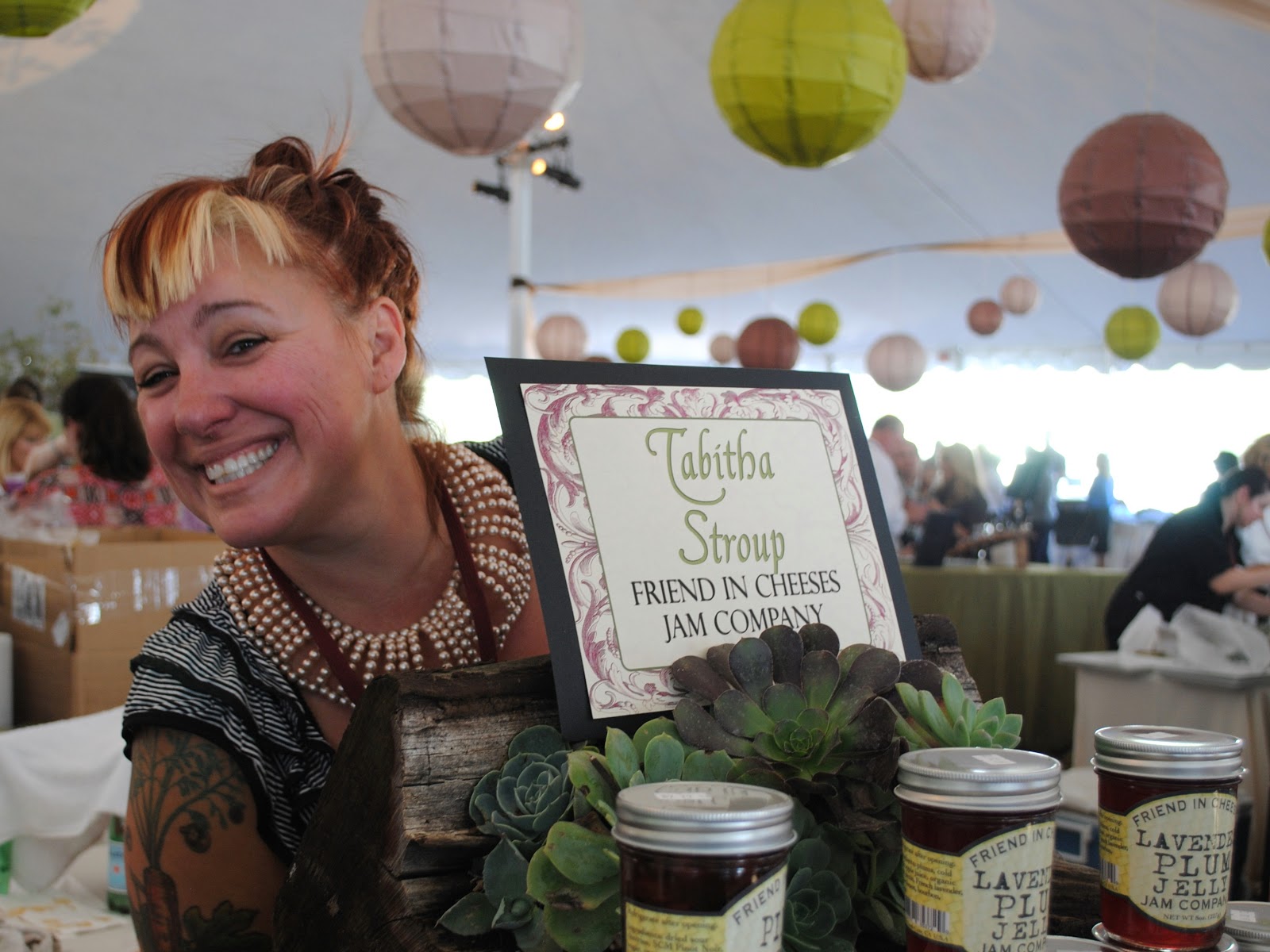
Other edible notables: Santa Cruz-based Tabitha Stroup of Friend in Cheeses Jam Company was serving her Lavender-Plum Jelly with gorgonzola, Rosie’s Hip Jelly on a spoonful of peppercorn chevre, and her Pinot Cherries on a slice of chorizo.

Todd Champagne of Happy Girl Kitchen in Pacific Grove had glass barrels full of pickled goodness to share – green beans, sliced turnips, thick cucumber coins, and enough delicious garlic cloves to keep an entire army of vampires at bay.

The Marin County-based Rustic Bakery offered a savory – their Olive Oil and Sel Gris Sourdough Flatbread with a smear of Cowgirl Creamery cheese – and a sweet – their Hazelnut and Sultana Pan Forte Crostini topped with cheese and a zesty orange marmalade.


Point Reyes Farmstead Cheese Company displayed an edible tower of their Original Blue alongside nothing but EcoTaster Mini spoons.  


And that was just the food. Remember the numbers I mentioned? 15 chefs and 50 wineries. Jenn and I tried to be strategic – tasting new-to-us wines, not old favorites, and sharing glasses – in order to sample as many of the offerings as we could. Still we ended up hitting only about a quarter of the vintners. But now we have some new favorites and it means that we’ll have to keep the list accessible and our eyes open for other chances to taste these wines.

We tried Fiddlehead Cellars’s “Seven Twenty Eight” 2008 Fiddlestix Pinot Noir. Supple stone fruit flavors with subtle spice at the end. This was a graceful, full-bodied red that I will definitely try again. Then we, die-hard Star Wars movie fans that we are, sauntered over to the Skywalker Ranch table and tasted their 2010 Pinot Noir. Yes, I know it’s a little like buying a wine for the label, but the wine was surprisingly good. Dark, complex, and serious. Like Darth Vader, except good, really good.

We were, unwittingly, on a Pinot Noir kick. There were plenty of other varietals, but as I look through the tick-marks and notes scribbled on my wine list, we sipped Ghost Writer’s 2010 Bell Farms Pinot Noir from Santa Cruz, Flying Goat Cellars’s Rio Vista Vineyard Dijon 2008 Pinot Noir from , and Martinelli’s 2010 Zio Tony Ranch Pinot Noir.

We broke our pinot streak – and our self-imposed rule of trying new-to-us wines – with Calcerous Vineyards’s 2009 York Mountain Cabernet Sauvignon. That’s been a favorite since we toured the winery in Paso Robles a few years back. Then I had to try Scarpetta’s 2010 Barbera del Monferatto for the name. ‘Scarpetta’ in Italian is, literally, little shoe, but it is also a colloquial expression for using a piece of bread to sop up the sauce left on your plate. Italians are divided into two groups: those who fare la scarpetta (do the shoe) and those who don’t. The population of the latter is much smaller than the former. Most brazen food lovers, me included, dig in – with our scarpette – with no regrets. So, when I saw the sign for Scarpetta, I had to try it.

My favorite wine of the afternoon was actually the first in our Pinot Noir parade: Copain’s 2009 Les Voisins Pinot Noir. Meaning “neighbors” in French, Copain’s Pinot Noir has light florals, deep red fruits, and an energetic, bright acidity. And as it was the perfect wine to end our afternoon, we went back for one last pour before we hit the road.

The Grand Public Tasting at the Big Sur Food & Wine Festival was an afternoon of culinary magic, an oenophilic paradise, and a place where food lovers converged and conversed with friends old and new…under the big top.