WHAT – Celebrating a Milestone for Edible Monterey Bay
Story and Photos by Camilla M. Mann
WHY

Milestones and accomplishments deserve to be celebrated with
free-flowing libations, scrumptious food, and scintillating conversations with
friends old and new. And that’s exactly how the people behind
Edible Monterey Bay wrapped up their
first year in print.
One of seventy magazines in the Edible Communities family
across the country, Edible Monterey Bay
– which is locally owned and operated by Sarah Wood of Carmel Valley – encourages
readers to get to know and support local growers, fishers, chefs, vintners, and
food artisans in the Santa Cruz, San Benito, and Monterey Counties. Their articles
and events all support their mission to celebrate the local food cultures by motivating
people to get involved in their local foodshed; they inspire people to explore
the land on which their food is grown, to meet who is cultivating that food,
and, finally, to enjoy innovative ways in which to prepare and present that
food – season by season.
WHERE
Tom and Constance Broz offered up their Live Earth Farm as
the venue for the first anniversary party and Tom kicked off the event with a
walking tour. With glasses in hand, party guests strolled along rows of
tomatoes and sunflowers and beneath trellised tunnels of apple trees while Tom shared
the history of his farm that was originally owned by the Mora family from the
Azores.
After apprenticing at the University of California at Santa
Cruz, Tom wanted to create a connection between customers and the land in the
form of a CSA, Community Supported Agriculture. The concept of community
supported agriculture – where consumers purchase directly from farmers –
originated in Japan in the 1960s. Called teikei,
the literal meaning is “partnership” or “cooperation,” but the term has grown
to mean something more along the lines of “food with a farmer’s face on it.” It
connects the farmers, the consumers, and the food.
Eighteen years ago, Tom founded Live Earth Farm on one and a
half acres with twenty-five CSA members, most of which were families at his
son’s preschool. He had two apprentices. Today Tom has thirty apprentices and
the farm occupies nearly one hundred acres on which they cultivate fifty
different crops throughout the year; their membership has soared to almost seven
hundred shares and they sell at six different farmers’ markets throughout the
week.
Sharing a snapshot of their grueling week during the regular
season, Tom detailed: “On Tuesday we box up 300 shares for our Wednesday
deliveries. Then we’re at the Felton famers’ market in the afternoon. On
Wednesday we deliver those shares that were boxed up on Tuesday, we sell at the
downtown Santa Cruz farmers’ market in the afternoon, and we box up another 250
shares for our Thursday deliveries. On Thursday we deliver those shares, box up
the remaining 150 shares, and prepare for the three weekend farmers’ markets.”
Tom described the process of dry-farming tomatoes and
grafting new varieties onto the root stock from the Mora family’s original
pippin trees.
While producing organic food to feed a community is a focus
of his farm, forging bonds with the community is even more important to Tom.
“It’s about relationships,” he declared. Live Earth Farm offers a winter CSA,
primarily to maintain his workforce year-round. Tom explained that most of his
workers are husband and wife teams. By growing and sharing crops through the
winter, he can ensure that at least one half of the couple will be able to work
– and earn an income – all year long.
After the tour, we returned to the shade of a colossal oak
tree where we recharged our flutes and goblets with some festive libations.
Kelly Dearie of Creative Cultures offered a trio of elixirs, including her Beet
Kvass, a traditional probiotic drink used in Russia as a “cure all,” and Pollen
Up, a seductive tonic made with bee pollen and raw, local honey. Equinox Champagne
Cellars poured their potation, a sparkling wine with a toasty, aromatic
quality. At another Edible Monterey Bay
event I attended, Barry Jackson, Equinox’s owner and winemaker, discussed
crafting his wine using the traditional French méthode champenoise, “More flavor results from the contact with the
yeast.” And Kate Appel, the force behind 3 of a Kind, shared a pair of her fresh-pressed
creations: an effervescent grapefruit juice infused with rosemary and an
apple-ginger juice blend that danced playfully on the tongue.
Guests chatted and mingled while platters of colorful, delectable
appetizers circulated. Mini polenta cups were filled with soft goat cheese and
topped with farm-fresh ratatouille and herbs. Crostini were smeared with a
honey-walnut crème, layered with beet and orange slices, and sprinkled with
snipped chives. Pan-fried padron peppers were skewered with olives, aged
cheese, and charcuterie.
On one side of the crowd, the plein air kitchen was a flurry
of activity – Chef Brad Briske, of Carmel’s Casanova Restaurant, and teams of helping
hands clipped stems, arranged flowers, peeled beets, layed out plates, scooped
crisped grape leaves from a simmering vat of oil, and garnished trays.
On the other side, the husband and wife duo Anne and Pete
Sibley – winners of the Great American Duet Sing-off on The Prairie Home
Companion – plucked and strummed their bluegrass tunes on their guitar and
banjo, filling the air with their distinctive folk sound.
The Sibleys just wrapped up a summer concert tour where they
appeared at festivals across the country. During the dinner, Anne and Pete
performed an a cappella song that they had written about community. Pete shared
that while they traversed the country on their summer tour, they lived in a bus
with their two young children. Everywhere they went people invited them in,
enveloping them with generosity and hospitality. He said that from Catskills
Mountains to the Pacific Northwest and everywhere in between, communities
welcomed them with warmth and open arms.
WHO
From the Edible
Monterey Bay staff, contributors, supporters, family, and friends – old and
new – there were so many members of the local good food community who rallied
together to make this celebration amazing. But it was the groundswell of groups
providing local youth with hands-on education in sustainable food systems and
the culinary arts who were in the spotlight. When the party moved inside the barn
that is the centerpiece of Live Earth Farm, people took their seats at three
long tables that were adorned with jelly jars filled with sunflowers, dahlias,
and marigolds in rich, autumn hues.

Wines from Storrs Winery of Santa Cruz and Heller Estate
Organic Vineyards of Carmel Valley lined the tables. And Chef Brad, along with
students participating in Lightfoot Industries, Food What?!, and Pie Ranch, began
his impressive parade of delicious courses punctuated by speakers from these
watershed vocational programs.
Santa Cruz native Carmen Kubas founded Lightfoot Industries
to provide entrepreneurial training for at-risk teenagers, utilizing a
for-profit restaurant, retail line, and innovative curriculum to model social,
environmental and fiscal responsibility. Students leave Lightfoot Industries
with a strong work ethic, marketable job skills, life skills, a clear career
pathway, and funding for continued education. One of Carmen’s students, who is
in her second year of the program, apologized in advance for the clichés, but
underscored the feeling of belonging, the sense of family, and the direction
that she now has because of Lightfoot. She spoke of floating aimlessly,
rudderless; now she knows that she wants to be a chef.
In 2002, Nancy Vail, along with two partners, purchased the
land on California’s central coast that would become Pie Ranch. Since 2005, Pie
Ranch has operated as a working farm where they “grow anything and everything
that you need to make a pie” and where youth from regional high schools can participate
in farm-based programs and activities. Additionally, Pie Ranch provides adult
education, offering aspiring farmers a resident-apprenticeship where they can spend
a full year immersed in all aspects of farm operations and marketing.
Food What?!’s Abby Bell shared two of her students who talked
about how the program has bolstered their confidence and increased their
responsibility. Food What?! is a youth empowerment and food justice program that
uses food – through sustainable agriculture and health – as a vehicle for
growing strong, healthy, and inspired teens. They partner specifically with
local, low-income and at-risk youth to grow, cook, eat, and distribute healthy,
sustainably raised food and address food justice issues in the community.

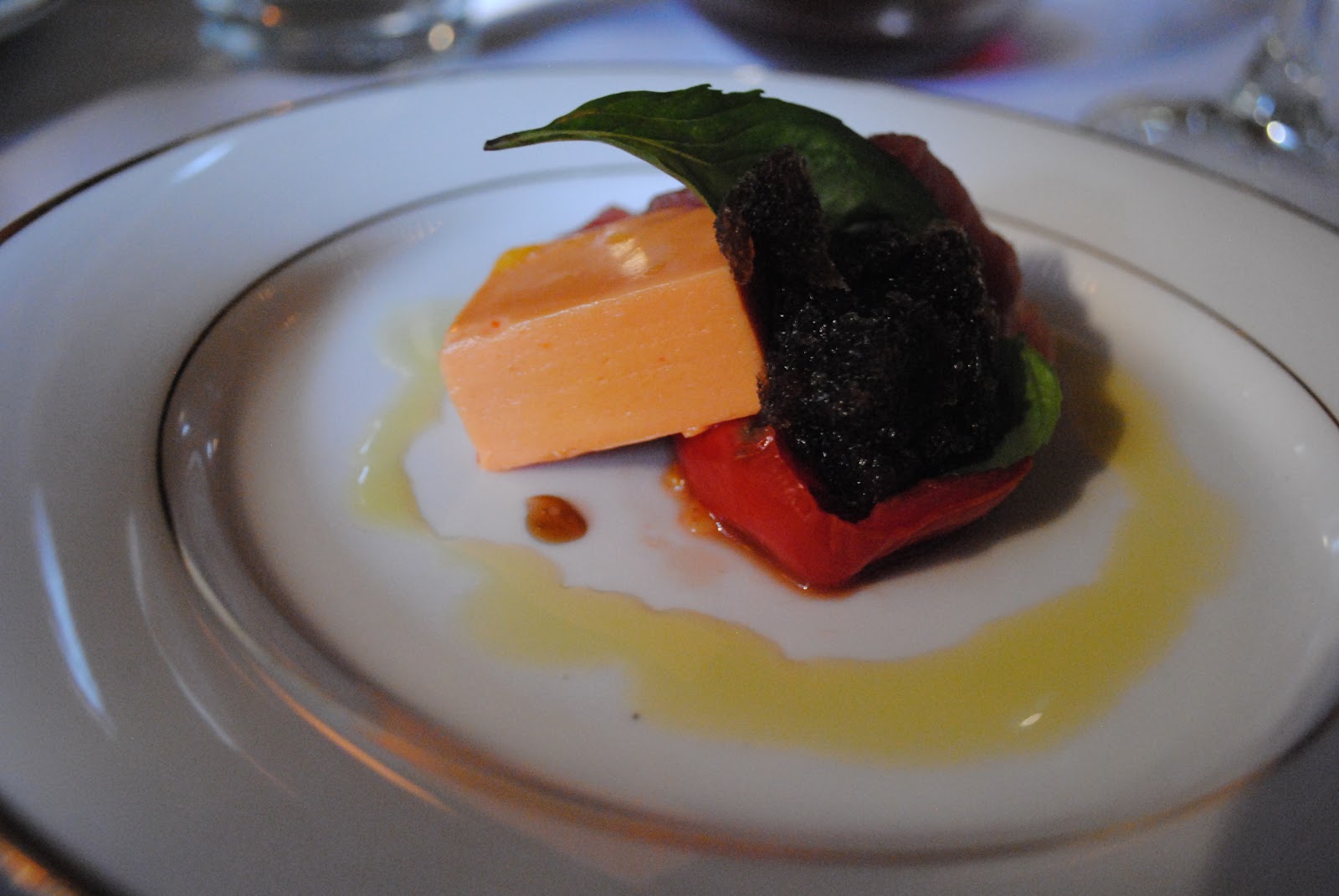
Watching these groups in action, we started with an albacore
crudo with fermented dry farmed tomato, tomato water “silken tofu” and balsamic
granita. Chef Brad called his second course ‘Clash of the Seasons
In Brodo’
because it combined roasted winter pumpkin and summer dry farmed tomato broth,
along with Pie Ranch wheat berries and shelling beans, Fogline Farm chicken,
sun gold tomatoes and crispy prosciutto.
The feast continued with Serendipity Farms butter lettuces,
borage dressed with a Petite Syrah vinaigrette followed by a main course of
Fogline Farm chicken and pork sausages paired with smoked fingerling potatoes,
a Serendipity medley of greens and winter root vegetables, and a sweet
apple-pear mostarda and aioli.
As the evening began to wind down, Pie Ranch and Lightfoot
Industries presented a duo of desserts featuring Fall’s darling, the apple.
Apple pies and apple-cranberry crisp pies were served with steaming mugs full
of strong, dark coffee.

The dinner was not just a celebration of good, local food
and Edible’s first anniversary, it was also an awards banquet.
Edible Monterey Bay honored its 2012
Local Heroes. Chef Tony Baker and Montrio Bistro earned “Best Chef/Restaurant”;
Jamie Collins, of Serendipity Farms, and Phil Foster, of Pinnacle Organics”
earned nods as “Best Farm/Farmer”; Baker’s Bacon by Chef Tony Baker took home
both “Best Food Artisan” and “Best Food Retailer”; and the honor of “Best
Nonprofit” was shared by GMO-Free Santa Cruz, Everyone’s Harvest, and MEarth
(pronounced ME/Earth). Capping off the evening was a special award for Jim
Kasson whose photo essay in the Fall 2011 issue of
Edible Monterey Bay included images taken from his series “This
Green Growing Land.”
There you have it: the what, the why, the where, and the who
of Edible Monterey Bay’s first
anniversary party. Just within earshot at my table, I was surrounded by purveyors,
farmers, writers, eaters, photographers, vintners, and even a couple who is on
the verge of opening their own restaurant. These people are the embodiment of
Monterey Bay’s amazing, local good food movement. Echoing Tom Broz’s sentiments
– it’s about relationships – and it’s
about the people. It’s an absolute pleasure to be a part of this community.
Happy anniversary, Edible Monterey Bay!


 The broccoli de cicco ($7 a platter)—a sweet heirloom
variety of broccoli—was chargrilled, slightly piquant and earthy, served with
vinaigrette and toasted hazelnuts. The caprese salad ($10 a plate) featured
heirloom tomatoes, garden fresh basil and olive oil from McEvoy Ranch in Marin
County. And the field green salad showcased two of summer’s stone fruit
darlings—pluots and white peaches from the farmers’ market.
 And for dessert, we shared fresh-baked cookies, cheesecake
flan ($5 per slice)—a charming marriage of cheesecake’s creaminess and flan’s
sweetness—and washed it all down with potent coffee drinks made with Mr.
Espresso beans.